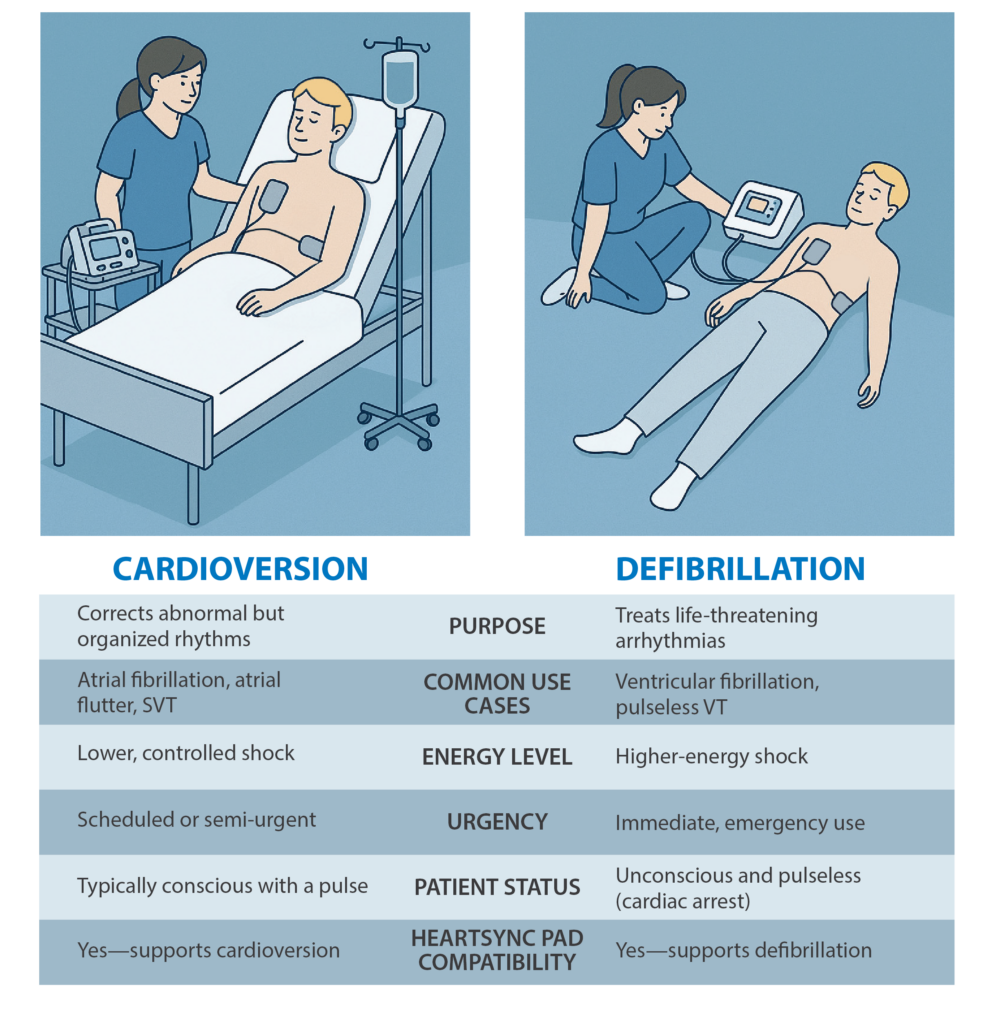
Cardioversion and defibrillation both use a defibrillator. However, they have different functions. In cardioversion, the shock is timed with the heart’s rhythm. This timing helps reset the beat without causing more disruption. In contrast, defibrillation delivers an immediate shock. The goal is to stop a chaotic rhythm so the heart can restart normally.
HeartSync™ pads by Nissha Medical Technologies are designed to support both. They create a strong connection between the patient and the defibrillator. As a result, clinicians can act quickly, whether the situation is planned or an emergency.
HeartSync Pad Compatibility

HeartSync pads support multiple functions. Functions include defibrillation, cardioversion, external pacing, and ECG monitoring.
Adult HeartSync pads can be used in either manual or AED mode. For AED or AED mode, they are intended for patients over 8 years old or weighing more than 55 pounds. In the manual mode, they can be used on patients over 22 pounds.
Pediatric HeartSync pads are intended to be used with defibrillators in manual mode that are capable of reducing energy below 100 Joules. They are not compatible with AEDs. These smaller pads are made for patients who weigh less than 55 pounds.
Before use, users should always review the device compatibility chart. This ensures the pads are used safely and correctly with each device.
Making the Right Choice Starts with the Right Tools
Understanding the difference between cardioversion and defibrillation is critical for patient care. Each requires quick thinking, clinical judgment, and reliable products. HeartSync pads by Nissha Medical Technologies are built to support both procedures. This gives clinicians the confidence to act fast and act correctly when it matters most.
To explore product options, view our literature, or reach out to our team.